
If you earn money or work in the Netherlands, you will generally pay Dutch income tax, known as inkomstenbelasting. Dutch residents are usually taxed on their worldwide income, while non-residents pay tax only on certain income from Dutch sources.
The Dutch system may seem complicated because income is divided into three categories, called “boxes.” Each box covers a different type of income and has its own rates and rules.
How Income Tax in the Netherlands Works
Most employees pay income tax through payroll withholding. Their employer deducts wage tax and social insurance contributions from their gross salary each month.
This means your gross salary (bruto salaris) is higher than the net salary (netto salaris) deposited into your bank account. Payroll withholding is an advance payment toward your final tax liability.
You may need to file an annual tax return if you:
- Are self-employed or run a business
- Have multiple sources of income
- Own substantial savings or investments
- Arrived in or left the Netherlands during the year
- Receive foreign income
- Want to claim deductions or request a refund
The Dutch Box System
Box 1: Work and Homeownership
Box 1 covers common forms of personal income, including:
- Employment wages, bonuses and tips
- Freelance or business profits
- Pensions, benefits and annuities
- Maintenance payments
- Certain foreign income
- Deemed income from an owner-occupied home
Box 1 uses progressive rates, so higher portions of your taxable income are taxed at higher percentages.
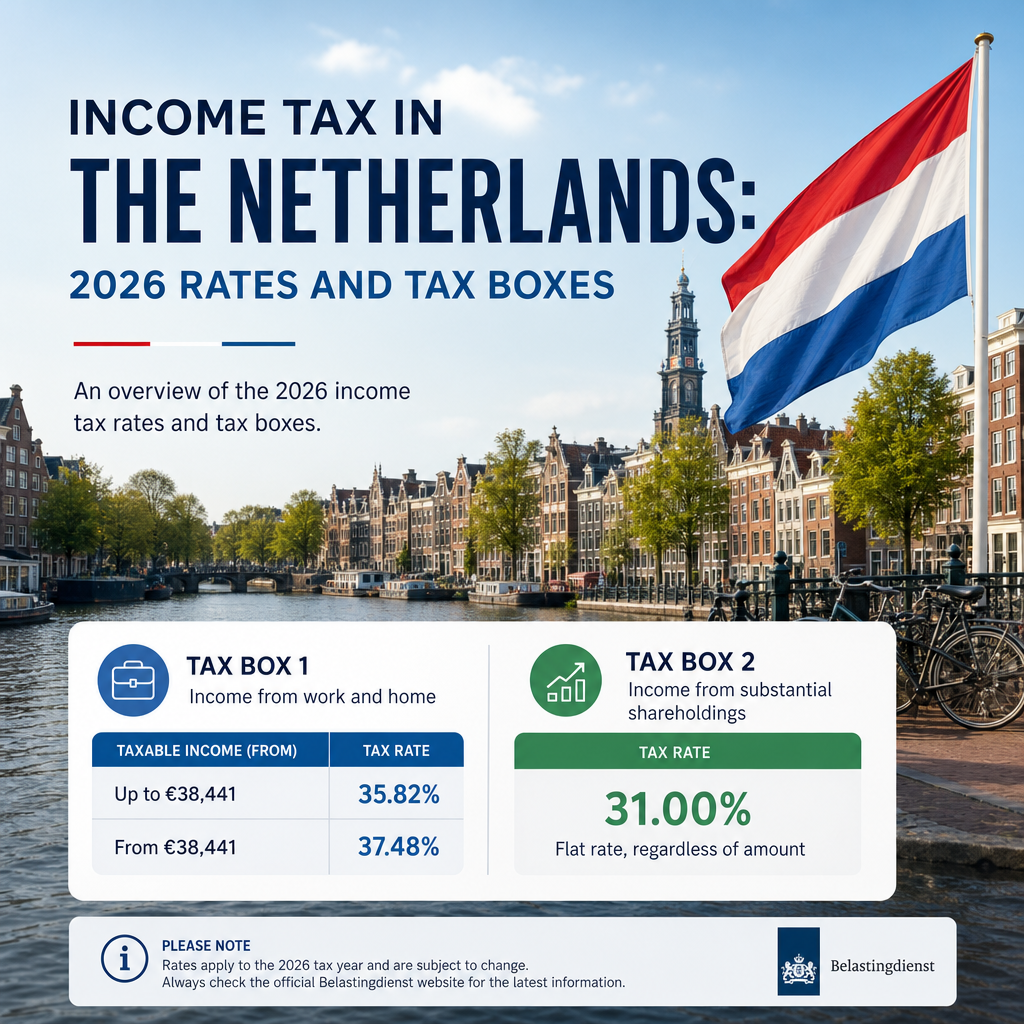
For taxpayers below state pension age, the proposed 2026 rates are:
| Annual taxable income | Total rate |
|---|---|
| Up to €38,883 | 35.75% |
| €38,883–€78,426 | 37.56% |
| Above €78,426 | 49.50% |
People who have reached the state pension age, or AOW-leeftijd, generally pay a lower rate in the first bracket because their national insurance position differs. Exact thresholds may also depend on their year of birth.
Box 2: Substantial Interests
Box 2 applies when you hold at least 5% of the shares or profit rights in a company, such as a Dutch BV. It covers income including:
- Dividend payments
- Capital gains from selling shares
- Other benefits connected to a substantial interest
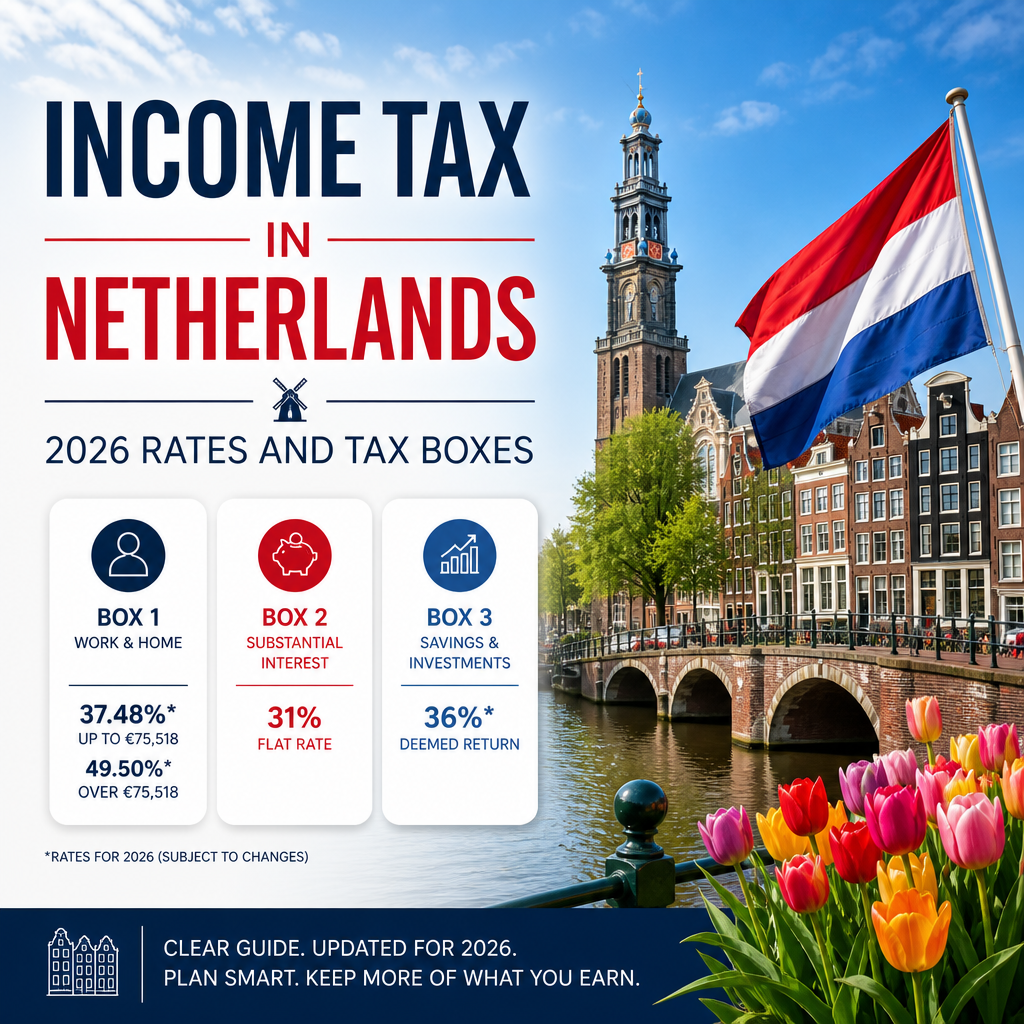
For 2026, taxable Box 2 income up to €68,843 is taxed at 24.5%, while income above that threshold is taxed at 31%.
Box 3: Savings and Investments
Box 3 concerns wealth such as savings and investments. Your position is normally measured on January 1 of the tax year.
Relevant assets can include:
- Bank savings
- Stocks and shares
- A second home
- Investment property
- Certain insurance products
Your principal residence normally belongs in Box 1 rather than Box 3. Personal belongings such as furniture and cars are also generally excluded unless held as investments.
For 2026, the Box 3 tax-free capital allowance is €59,357 per person or €118,714 for qualifying tax partners. The Box 3 tax rate is 36%, applied to the calculated taxable return rather than directly to the entire value of your assets. Box 3 rules have changed following court decisions, so checking the current Belastingdienst calculation method is important.
Tax Credits and Deductions
Dutch taxpayers may qualify for credits that reduce the tax they owe. The main examples are:
- General tax credit (algemene heffingskorting)
- Employment tax credit (arbeidskorting)
- Other credits based on age or personal circumstances
Employers normally account for applicable payroll tax credits when calculating salaries. Self-employed workers claim them through their annual return.
Potential deductions may include mortgage interest on a principal residence, qualifying charitable donations, alimony, certain healthcare expenses and some pension-related premiums. Eligibility conditions apply, and not every work expense is personally deductible.
The 30% Ruling for Expats
Some employees recruited from abroad may qualify for the 30% ruling, subject to salary, recruitment and application requirements. Under the traditional arrangement, an employer can pay up to 30% of qualifying employment income as a tax-free allowance for extraterritorial costs.
The rules have changed several times and are scheduled to change again, including a possible reduction to 27% from 2027. Expats should verify the conditions that apply to their employment period rather than assuming automatic eligibility.
Filing a Dutch Tax Return
The annual income tax return is called the aangifte inkomstenbelasting. Even when payroll tax has already been deducted, filing may be necessary to reconcile your final liability.
A return can account for mortgages, investments, foreign income, deductible expenses and your partner’s financial circumstances. Tax partners may allocate some income and deductions between them in the most beneficial way. They may also receive a combined Box 3 exemption.
The Belastingdienst will often notify you when filing is compulsory. However, voluntary filing can be worthwhile if you expect a refund. Consult the official Belastingdienst income tax guidance for current filing information.
Avoiding Double Taxation
The Netherlands has tax treaties with many countries. These agreements determine which country may tax specific income and help prevent the same income from being taxed twice.
International workers, property owners and business owners should check the relevant treaty and keep complete records. Undeclared income or assets can result in substantial penalties, so professional advice may be valuable when dealing with cross-border finances or complex income tax in the Netherlands.
For more practical information for residents and expats, visit Admun.eu.