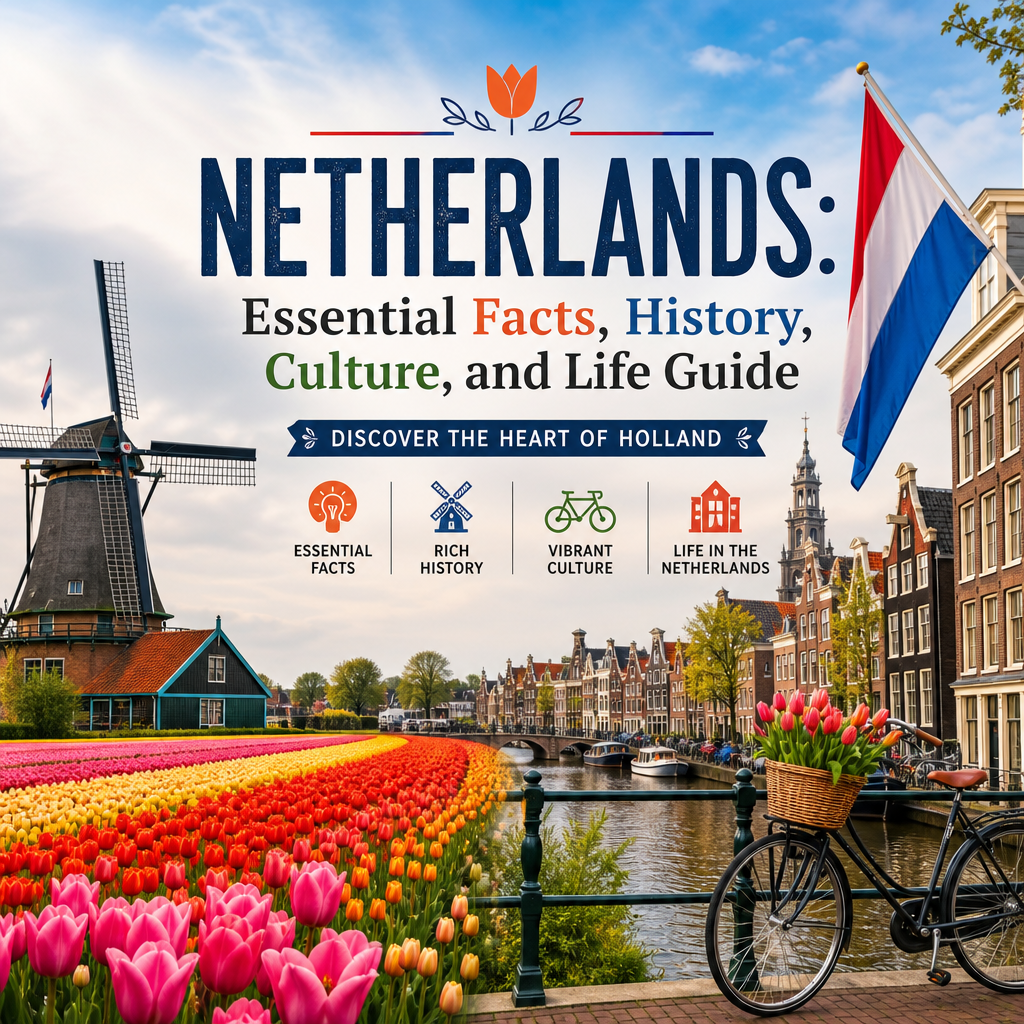

The Netherlands is famous around the world for its tall people, windmills, tulips, clogs, canals, bicycles, and remarkably flat landscape. Yet this small country in northwestern Europe is much more than a collection of familiar images. It is also known for its progressive society, strong economy, direct communication style, efficient infrastructure, and centuries of innovation.
With almost 18 million inhabitants living across just 41,543 square kilometres, the Netherlands is one of the most densely populated countries in Europe. Whether you are moving for work, joining family, studying, or simply planning a visit, understanding the country’s geography, history, government, customs, and everyday life can make your experience much richer.
Quick Facts About the Netherlands
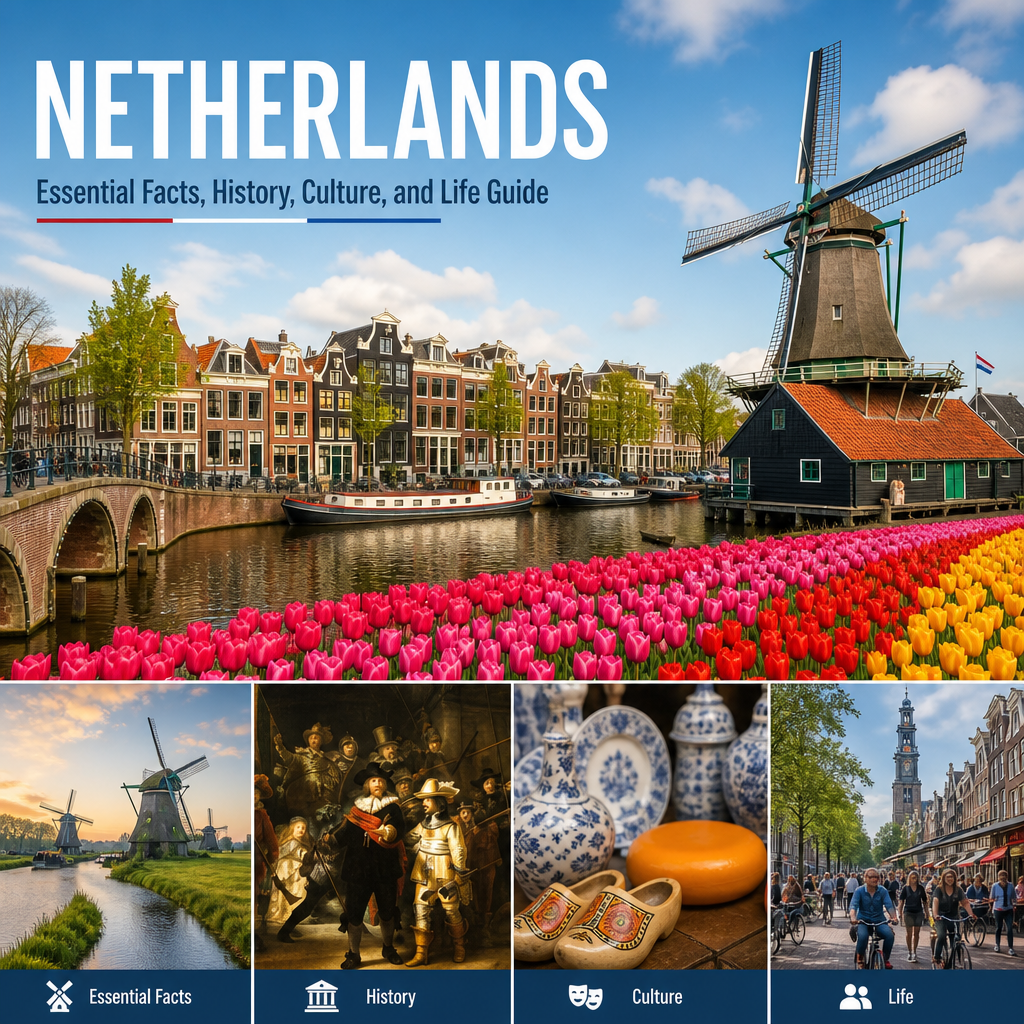
Here are some essential facts to help you get acquainted with the country:
- Population: Approximately 17.8 million
- Official national language: Dutch
- Official regional languages: West Frisian, English, and Papiamento in specific areas
- Average life expectancy: Approximately 81 years
- Motto: Je maintiendrai — “I will uphold”
- National anthem: Wilhelmus
- Capital: Amsterdam
- Seat of government: The Hague
- Government: Unitary parliamentary constitutional monarchy
- Monarch: King Willem-Alexander
- Currency: Euro
- Total land surface: Approximately 33,948 square kilometres
- Highest point: Vaalserberg, 322.7 metres above sea level
- Lowest point: Prince Alexander Polder, 6.76 metres below sea level
Although Amsterdam is the official capital, The Hague is where the government, parliament, and many international institutions are based.
A Country Shaped by Water
Water is central to Dutch geography and history. Roughly one-third of the Netherlands lies below sea level, while another third is close to the official Dutch reference level known as NAP. Much of the country has been created, protected, or reshaped through an elaborate system of dikes, dams, canals, pumping stations, and polders.
A polder is land reclaimed from water and kept dry through drainage. This constant relationship with water has influenced Dutch engineering, politics, farming, and culture for centuries. The famous saying that “God created the world, but the Dutch created the Netherlands” reflects the country’s long tradition of land reclamation.
The landscape is generally flat, although the southern province of Limburg is more hilly. Vaalserberg, in the far southeast, is the country’s highest point. It is modest by international standards, but it feels unusually elevated in a nation known for its broad plains and low horizons.
Amsterdam, Canals, and Bicycles
Amsterdam was founded in 1275 around a dam on the Amstel River. Today, the city is famous for its historic canal ring, narrow houses, museums, and lively neighborhoods. The city has approximately 1,281 bridges and is built largely on wooden and concrete piles driven deep into the soft ground.
Amsterdam is also a city designed around bicycles. Across the Netherlands, there are more bicycles than cars, and the country has more than 15,000 kilometres of cycle paths. Cycling is not limited to recreation. People use bikes to commute to work, take children to school, shop, and connect with trains and buses.
For newcomers, Dutch cycling culture can take some adjustment. Bike lanes often have priority, cyclists may move quickly, and bicycles are an essential part of urban transport. Learning the basic road rules and paying attention to bike paths is important for both cyclists and pedestrians.
Dutch Society and Communication
The Dutch are often described as direct, practical, and open-minded. In conversation, people may express an opinion clearly rather than using indirect language to avoid disagreement. This directness is generally intended to be honest and efficient, not rude.
Dutch society also places value on equality and informality. Workplaces may have relatively flat hierarchies, and employees are often encouraged to share their views. It is common to address colleagues and managers by their first names.
The Netherlands has a reputation for social progressiveness. It was the first country in the world to legalise same-sex marriage, doing so in 2001. It has also been associated with liberal approaches to personal freedom, social welfare, environmental planning, and work-life balance.
Part-time employment is particularly common. Around four in ten employees work part time, giving the Netherlands one of the highest part-time employment rates in the European Union. This reflects a broader cultural emphasis on balancing professional responsibilities with family, leisure, and personal time.
The Dutch Language
Dutch is the main language of the Netherlands, although English is widely spoken, especially in larger cities and among younger people. The country also recognises several regional or local languages, including West Frisian in Friesland and Papiamento in the Caribbean part of the Kingdom.
Learning basic Dutch can still be extremely useful. Even simple phrases can help with daily life, local relationships, government services, and integration.
Some useful expressions include:
- Hallo — Hello
- Goedemorgen — Good morning
- Dank je wel — Thank you
- Alsjeblieft — Please or here you are
- Tot ziens — Goodbye
- Hoe gaat het? — How are you?
- Spreekt u Engels? — Do you speak English?
Dutch people may quickly switch to English when they hear an accent, but that should not discourage newcomers from practising Dutch.
A Short History of the Netherlands
The history of the Netherlands includes medieval cities, maritime trade, religious conflict, colonial expansion, political change, and technological achievement.
Amsterdam was established long before the modern Dutch state. The Kingdom of the Netherlands was founded in 1814, following the Napoleonic period, and William I became its first king in 1815.
The seventeenth century is often called the Dutch Golden Age. During this period, Dutch merchants, artists, scientists, and explorers gained international influence. Amsterdam became a major centre of global trade, while artists such as Rembrandt van Rijn and Johannes Vermeer produced works that remain famous today.
Vincent van Gogh, one of the world’s most influential painters, was born in the Netherlands in 1853. His work, including The Starry Night and Sunflowers, is celebrated internationally, and the Van Gogh Museum in Amsterdam houses the largest collection of his paintings and drawings.
Dutch women gained the right to vote in national elections in 1919. In the twentieth century, the country experienced occupation during the Second World War, post-war reconstruction, economic growth, and the development of its modern welfare state.
Government and the Dutch Monarchy
The Netherlands is a unitary parliamentary constitutional monarchy. The monarch is the head of state, while political leadership is exercised by the government and the prime minister.
The Dutch parliament consists of two chambers:
- The House of Representatives, or Tweede Kamer, has 150 seats and plays the central role in proposing, debating, and scrutinising legislation.
- The Senate, or Eerste Kamer, has 75 seats and reviews legislation passed by the lower house.
National elections are generally held every four years, although an early election may take place if a government loses its parliamentary support. For current details, consult the official Dutch government information.
The current monarch is King Willem-Alexander. His mother, Princess Beatrix, abdicated on 30 April 2013, making him the youngest reigning monarch in Europe at that time. Queen Wilhelmina, who reigned from 1890 to 1948, remains the longest-serving Dutch monarch.
The Dutch monarchy has mostly ceremonial and constitutional responsibilities. Members of the royal family attend national events, represent the country abroad, and perform official duties.
Elections and Expat Voting Rights
The Netherlands holds several types of elections, including elections for:
- The House of Representatives
- The Senate, elected indirectly by provincial representatives
- Provincial councils
- Municipal councils
- The European Parliament
Voting rights depend on nationality and residence. Dutch citizens can vote in national, provincial, municipal, and European elections, provided they meet the relevant requirements. Citizens of other European Union countries living in the Netherlands may generally vote in municipal and European elections under certain conditions.
Non-EU residents may be eligible to vote in municipal elections if they meet residency and registration requirements. Because rules can vary, residents should check official information before an election.
Weather and Seasons
The Dutch climate is maritime, meaning it is strongly influenced by the North Sea. Winters are generally cool rather than severely cold, while summers are mild to warm. Rain can occur throughout the year, and conditions may change quickly.
Typical seasonal patterns include:
- Spring: Cool or mild temperatures, fresh green landscapes, and the famous tulip season.
- Summer: Longer days, moderate warmth, outdoor festivals, and busy beaches and parks.
- Autumn: Windy weather, changing leaves, and frequent rain.
- Winter: Short days, chilly temperatures, occasional frost, and sometimes snow or ice.
The Netherlands does not necessarily receive dramatically more rain than many other European countries, but showers and wind are common enough to make a waterproof jacket and practical shoes useful in every season.
Dutch Food and Drinks
Traditional Dutch food is often simple, filling, and influenced by the country’s agricultural history. Popular dishes include:
- Stamppot: Mashed potatoes mixed with vegetables, often served with sausage.
- Hutspot: Potatoes, carrots, and onions cooked together.
- Snert: A thick pea soup, especially popular in winter.
- Bitterballen: Deep-fried savoury snacks filled with ragout.
- Frikandel: A popular skinless minced-meat snack.
- Herring: Often served with onions and pickles.
- Poffertjes: Small, fluffy pancakes served with butter and sugar.
- Gouda cheese: One of the country’s best-known cheeses.
Beer is widely enjoyed, with both large breweries and an expanding independent craft-beer scene. Jenever, a traditional Dutch juniper spirit, is considered a predecessor of modern gin and has a long history in the Netherlands.
Tulips, Carrots, and Agriculture
The Netherlands is a global leader in agriculture despite its relatively small size. It is the world’s leading producer and exporter of tulips and one of the world’s largest agricultural exporters overall.
The country is especially well known for producing peppers, tomatoes, cucumbers, flowers, and other greenhouse crops. Advanced horticultural technology allows Dutch farmers to produce high yields using limited land and carefully managed resources.
Orange is the national colour because of the House of Orange, the Dutch royal line. Interestingly, orange carrots were developed in the Netherlands during the sixteenth century, reportedly in honour of the House of Orange. Before then, carrots could be white, yellow, black, purple, or red.
Everyday Dutch Life
Daily life in the Netherlands is shaped by convenience, planning, and public infrastructure. Trains, buses, trams, and cycling routes connect cities and towns efficiently. Many people organise their schedules carefully, and punctuality is generally appreciated.
The country also has one of the highest concentrations of museums in the world. In addition to major institutions such as the Rijksmuseum, the Van Gogh Museum, and the Mauritshuis, there are museums dedicated to science, maritime history, local traditions, design, and even unusual subjects.
For families moving to the Netherlands, practical matters may include registering with the municipality, arranging health insurance, finding schools, opening a bank account, and understanding local cycling and transport rules. Those bringing pets should also research identification, vaccinations, pet passports, and insurance requirements.
Conclusion
The Netherlands is a small but remarkably influential country. Its identity has been shaped by water management, international trade, art, agriculture, cycling, social innovation, and a strong sense of practicality. Behind the familiar images of tulips and windmills is a modern, densely populated, highly organised society with a rich and complex history.
Whether you are relocating for work, joining family, studying, or exploring the country as a visitor, learning about Dutch language, customs, government, food, weather, and geography is an excellent way to feel more at home. Welcome to the Netherlands—a country where land is reclaimed from water, bicycles outnumber cars, and tradition and progress often travel side by side. For questions about this guide or the site, visit Contact Admun.